Oura Ring Size · Independent Sizing Resource · Updated August 2026
Oura Ring tracks over 50 health metrics and rolls them into three daily scores — Sleep, Readiness, and Activity — plus dedicated features for stress, temperature, and women’s health. Here’s what it actually measures, and how each piece works.
The Three Core Daily Scores
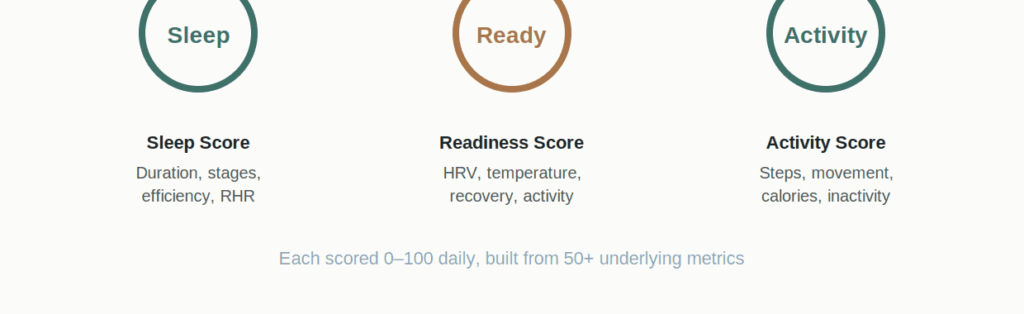
Sleep Score reflects total sleep time, time spent in REM and deep sleep, resting heart rate, body temperature, and sleep efficiency. Readiness Score estimates how prepared your body is for the day by combining sleep quality, HRV changes, resting heart rate, body temperature, and recent activity and recovery. Activity Score looks at movement, calories burned, inactivity time, steps, and recovery. All three are scored on a 0–100 scale and recalculated daily.
How Oura Measures Heart Rate and HRV
Heart rate and heart rate variability sit at the center of most of Oura’s other metrics. The ring measures continuously — red and infrared LEDs during sleep, green and infrared LEDs during waking hours — and calculates resting heart rate from the lowest stable readings captured during deep sleep. HRV is measured using RMSSD (Root Mean Square of Successive Differences), the standard approach used in clinical and research settings, captured in 5-minute windows throughout the night and averaged across the full sleep period.
Does Oura Ring measure stress?
Yes, through a feature Oura calls Daytime Stress, which uses continuous HRV, heart rate, and temperature data collected during waking hours to assess how your nervous system is handling load throughout the day. It’s a newer addition alongside Oura’s existing overnight recovery tracking, extending the same underlying signals into daytime use rather than only reporting on sleep.
Does Oura Ring track steps?
Yes — steps are one of several inputs that make up the Activity Score, alongside overall movement, calories burned, inactivity time, and recovery. It’s tracked continuously in the background rather than as a standalone feature you have to turn on.
Body Temperature, SpO2, and Recovery Signals
Oura tracks deviations from your personal baseline body temperature, which can flag illness, recovery strain, or cycle-related patterns before you’d necessarily notice them yourself. Blood oxygen (SpO2) is also tracked overnight as part of the broader respiratory and recovery picture the ring builds over time.
Women’s Health Tracking
Beyond period tracking, Oura extends into menopause and perimenopause tracking through a symptom questionnaire that helps contextualize where someone is in that transition, tying it back into how it affects sleep and readiness data over time.
What’s New in Ring 5
The most recent generation added a handful of features beyond hardware changes: GLP-1 insights for people using medications like semaglutide for weight management or type 2 diabetes, plus two new proactive capabilities Oura calls Health Radar — blood pressure signals and nighttime breathing analysis. These sit on top of the existing metric set rather than replacing anything from earlier generations.
Free vs. Membership: What You Get Without Subscribing
Without an active Oura Membership, the ring still measures its core metrics — sleep stages, resting heart rate, and the daily scores — but historical data access is limited to roughly a week, and you lose the longer-term trend analysis and personalized insights the membership unlocks. The membership itself runs a recurring monthly or annual fee and is what most reviews are referring to when they mention Oura’s subscription.
If you’re comparing Oura against a subscription-free competitor specifically because of this fee, that’s a legitimate factor — see our comparison pages for how other smart ring brands handle subscriptions differently.
Frequently Asked Questions
What metrics does Oura Ring track?
Over 50 metrics feeding into Sleep, Readiness, and Activity scores, plus dedicated tracking for HRV, resting heart rate, body temperature, SpO2, daytime stress, and women’s health signals.
How does Oura measure stress?
Through its Daytime Stress feature, which uses continuous HRV, heart rate, and temperature readings collected while you’re awake to assess nervous system load throughout the day.
Does Oura Ring track steps?
Yes, as one of several inputs to the Activity Score, tracked continuously alongside movement, calories, and inactivity time.
Do you need a subscription to use Oura Ring?
No, but the free tier is limited — core metrics and scores still work, but historical data and personalized insights require an active membership. See our Oura Ring size guide if you’re still deciding on the ring itself before weighing the subscription question.
This guide is published by Oura Ring Size, an independent sizing resource not affiliated with, endorsed by, or sponsored by Oura Health Oy. “Oura” and “Oura Ring” are trademarks of Oura Health Oy, referenced here only to describe compatibility. Feature availability varies by ring generation and membership status, and may change — confirm current features directly with Oura before purchase.